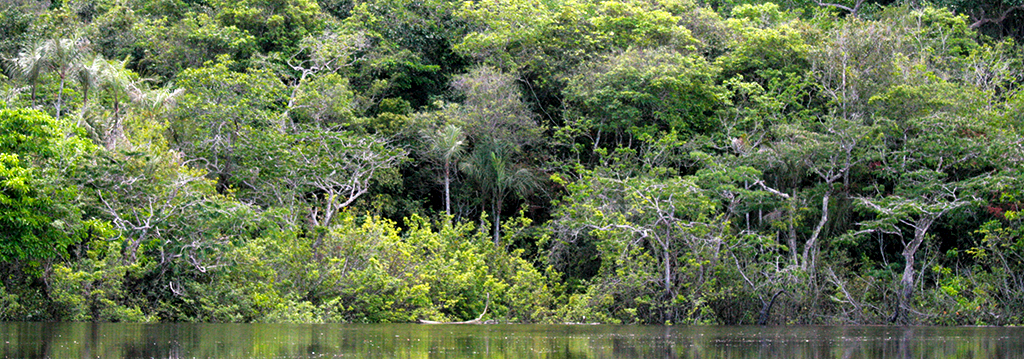
Guyana’s tropical rainforests protected under the REDD program provide not just natural resources but an income stream to the country.
DISCOVER MAGAZINE
Two hours south of Georgetown, Guyana, a paved highway recedes, giving way to a rutted red road gushing through thick rainforest. In its muddiest spots, the road swallows trucks and spits them out at dangerous angles. Many hours later, it leads to an area of protected land called Iwokrama, a Rhode Island-size forest in the heart of Guyana, crowded with ancient buttress-trunked trees draped in liana vines.
Since 2003, Jake Bicknell has been a fixture within this forest. Now a doctoral student in biodiversity management at the U.K.’s University of Kent, he is cataloging Iwokrama’s iconic and bizarre species, including jaguars, giant anteaters, anacondas, and scads of birds and bats. (Guyana boasts more than 700 bird and 120 bat species.)
Specifically, he’s in Iwokrama to find out how logging affects tropical forest wildlife. Conventional logging ruins forests and decimates species, but low-impact methods of harvesting timber might not be so damaging. In fact, Bicknell believes selective logging can become a tool for protecting the forests and biodiversity of Guyana — a developing country eager to tap its natural resources as a way to boost its economy.
“There will always be a market for products extracted from forests, so the point is to do it in the least impacting way,” says Bicknell.
Place of Refuge
Iwokrama provides the perfect setting for Bicknell’s work. The reserve was established as a rainforest research center in 1996, with half of its land remaining untouched while the other half is set aside for sustainable logging, ecotourism and the production of crabwood oil from carapa seed by forest-dwelling communities.
At Iwokrama, which means “place of refuge” in the Amerindian language of Makushi, forest managers harvest timber using a technique called reduced-impact logging. They must generate maps identifying every tree they intend to cut, targeting ones at least 13.8 inches in diameter at chest height and more than 24 feet apart. And they identify the best direction to fell trees, carefully planning the paths used to drag timber out of the forest. Done properly, such practices kill fewer trees and leave only small gaps in the canopy, bringing in just enough light to encourage the growth of seedlings, so that foresters don’t need to replant.
In contrast to sustainable forestry, conventional logging tends to open up big holes in the canopy, letting light pour into the normally dark and humid forest, drying it out. Plants die. Animals die or move on. And conventional logging roads can wash fuel and sediment into nearby waterways and introduce farming, mining and illegal hunting.
Bicknell was familiar with research on the benefits of reduced-impact logging for forest preservation, but few studies had examined how sustainable forestry practices affected wildlife in the rainforest. Iwokrama offered an ideal opportunity to survey mammals, birds and bats in both unlogged and selectively logged areas, to see if reduced-impact logging put a dent in biodiversity.
He began in 2008 with standard wildlife surveys, observing species at six sites — three logged and three unlogged, including two in a forest adjacent to Iwokrama. For weeks, Bicknell and the Amerindian observers he hired trudged along, at about a mile per hour, scanning the forest for spider monkeys, red-rumped agoutis and more.
Keep reading this story in the November 2013 issue of Discover.
Leave a Reply