Category: policy / funding

  • Ozone-hole treaty slowed global warming

    Ozone-hole treaty slowed global warming

    Montreal Protocol helped to curb climate change and so did world wars and the Great Depression.

    Human actions that were not intended to limit the greenhouse effect have had large effects on slowing climate change. The two world wars, the Great Depression and a 1987 international treaty on ozone-depleting chemicals put a surprising dent in the rate at which the planet warmed, says research published today in Nature Geoscience1.

    Francisco Estrada, an ecological economist at the Free University in Amsterdam, and his colleagues analysed annual temperature data collected from 1850 to 2010, as well as trends in emissions of greenhouse gases such as carbon dioxide, methane and chlorofluorocarbons (CFCs) — ozone-depleting substances that also trap heat in the atmosphere — between 1880 and 2010.

    Instead of relying on climate-model simulations, the researchers used a statistical approach that they say helped them to get a better look at how components of the climate system contribute to its warming or cooling by trapping heat, an effect called radiative forcing. They found that changes in warming coincided with human-initiated adjustments in greenhouse-gas emissions.

    A cooling period between 1940 and 1970 had previously been chalked up to natural variability and the Sun-shielding effect of pollution emitted by European industries, as they recovered after the Second World War. But Estrada and his colleagues found that it followed a reduction in greenhouse-gas emissions associated with economic downturns, when industries were less active. Significant drops in emissions occurred during the First World War, the Great Depression of the 1930s and the Second World War.

    “When the wars end and you have large economic growth, the emissions of CO2 rise fast and you have the onset of modern climate change,” says Estrada.

    Keep reading this article in Nature.

    Image by Scott Witt via Flickr.

  • Lady of the Lakes

    Lady of the Lakes

    Nature

    Diane Orihel set her PhD aside to lead a massive protest when Canada tried to shut down its unique Experimental Lakes Area.

    It was an ominous way to start the day. When she arrived at work on the morning of 17 May 2012, Diane Orihel ran into distraught colleagues. Staff from Canada’s Experimental Lakes Area had just been called to an emergency meeting at the Freshwater Institute in Winnipeg. “It can’t be good,” said one. (more…)

  • In carbon sequestration, money grows on trees

    In carbon sequestration, money grows on trees

    Guyana’s tropical rainforests protected under the REDD program provide not just natural resources but an income stream to the country.

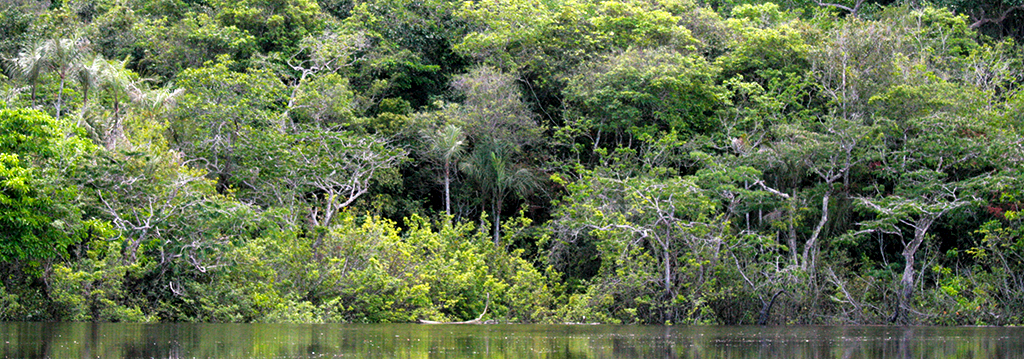
    Two hours south of Georgetown, Guyana, a paved highway recedes, giving way to a rutted red road gushing through thick rainforest. In its muddiest spots, the road swallows trucks and spits them out at dangerous angles. Many hours later, it leads to an area of protected land called Iwokrama, a Rhode Island-size forest in the heart of Guyana, crowded with ancient buttress-trunked trees draped in liana vines.

    [media-credit name=”Hannah Hoag” align=”alignleft” width=”300″]red-mud-guyana[/media-credit]Since 2003, Jake Bicknell has been a fixture within this forest. Now a doctoral student in biodiversity management at the U.K.’s University of Kent, he is cataloging Iwokrama’s iconic and bizarre species, including jaguars, giant anteaters, anacondas, and scads of birds and bats. (Guyana boasts more than 700 bird and 120 bat species.)

    Specifically, he’s in Iwokrama to find out how logging affects tropical forest wildlife. Conventional logging ruins forests and decimates species, but low-impact methods of harvesting timber might not be so damaging. In fact, Bicknell believes selective logging can become a tool for protecting the forests and biodiversity of Guyana — a developing country eager to tap its natural resources as a way to boost its economy.

    “There will always be a market for products extracted from forests, so the point is to do it in the least impacting way,” says Bicknell.

    Keep reading this story in the November 2013 issue of Discover

  • Accord could make Canadian generics industry a ‘rust bucket’

    Accord could make Canadian generics industry a ‘rust bucket’

    A trade agreement in negotiations between Canada and the EU is drawing the ire of generic drugmakers, provincial governments and patient advocates over proposals to extend drug patents by several years in Canada, a move that critics say would delay the arrival of generic medicines to market in that country and inflate healthcare costs.

    According to Canada’s Department of Foreign Affairs and International Trade, Canada imports C$8.4 billion ($8.2 billion) of pharmaceutical products from the EU annually, making Canada the fifth largest export market for the continent’s drugmakers. The sweeping Comprehensive Economic and Trade Agreement (CETA) could add another $2.8 billion to the annual bill, according to a report by health economists Paul Grootendorst, from the University of Toronto, and Aidan Hollis, from the University of Calgary (J. Generic Med. 8, 81–103, 2011). This cost is largely shouldered by the provincial and territorial governments, which pay for healthcare.CETA—first proposed in 2009 and subsequently leaked in 2010—calls on Canada to beef up its intellectual property rights for pharmaceuticals. The proposed changes would add five years to patents for drugs that are unduly bogged down in the regulatory approval process, lengthen the period of time clinical trial data is kept off-limits for use by generics companies from eight years to ten years (or even longer in the case of pediatric drugs) and grant brand-name companies an appeal process to challenge generics companies on their patent compliance. (more…)

    Nature Medicine 18, 991 (2012)

    Published online 06 July 2012

  • Canadian satellite system under budget cloud

    Canadian satellite system under budget cloud

    Nature

    Missed deadlines and an underfunded Canada Space Agency (CSA) may scuttle plans to build the next generation of earth observing satellites, according to the Canadian satellite company pegged to build them.

    In 2010, the CSA selected MacDonald, Detwillier and Associates Ltd. to design the successor to Radarsat-2, the agency’s current earth observing satellite. The company came up with a three-satellite system that would provide information for maritime surveillance, disaster management and ecosystem monitoring. But Dan Friedman, the company’s president and chief executive officer, says the federal government missed a target deadline for awarding the building contract in January, according to a story in the Globe and Mail and the CSA may not have enough money for the project.

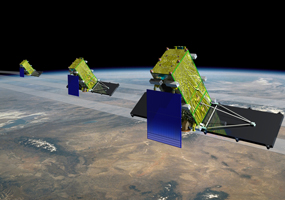
    The Radarsat Constellation calls for three satellites (scalable to six) to maintain a polar orbit and provide radar images of nearly all of Canada’s land and waters. The Constellation would monitor ice and icebergs, winds and oil pollution in shipping lanes and coastal zones on a daily basis. It would also provide information on the state of Canada’s forests, changes to vegetation in protected areas and important wildlife habitat, and monitor wetlands and coastal change.  Unlike Radarsat-2, which is owned by MDA, the Canadian government would own Constellation.

    Canada’s Earth observing satellites, Radarsat-1 and -2, have been important in mapping natural disasters, such as the 2011 flooding in Queensland, Australia, as well as the Antarctic’s glaciers and ice sheets. including a subsurface view of the ice-covered Lake Vostok.

    Keep reading this story at Nature.