Category: policy / funding

  • Canadian research shift makes waves

    Canadian research shift makes waves

    McDougallNRC

    Agency’s focus on industry-driven projects raises concerns that basic science will suffer.

    Published in Nature, 19 April 2011.

    Canada’s largest research entity has a new focus — and some disaffected scientists. On 1 April, the National Research Council (NRC), made up of more than 20 institutes and programmes with a total annual budget larger than Can$1 billion (US$1 billion), switched to a funding strategy that downplays basic research in favour of programmes designed to attract industry partners and generate revenue. Some researchers suggest that the shift is politically driven, because it brings the agency into philosophical alignment with the governing Conservative Party of Canada, which is in the middle of an election campaign.

    The change was announced in a memo from NRC president John McDougall on 2 March, and involves the transfer of authority over 20% of the agency’s research funds and the entire Can$60-million budget for large equipment and building costs to the NRC’s senior executive committee, which will direct it towards research with a focus on economic development, rather than pure science. Until now, individual institutes have had authority over research spending. McDougall wrote that in future, 80% of the research budget will be centralized, with “curiosity and exploratory activities” to be funded by the remaining 20%.

    In Canada, most funding for academic researchers flows through agencies other than the NRC. However, with 4,700 scientists, guest researchers, technologists and support staff pursuing specialities from astrophysics to plant biotechnology at its institutes, the NRC plays a vital part in the nation’s scientific community, as a generator of original research and a service provider to government and industry. The shift away from basic science “weakens” the NRC’s labs, because they “are required to bridge two cultures — the basic and applied”, says John Polanyi, a Nobel laureate and a chemist at the University of Toronto.

    But in a follow-up memo on 24 March, McDougall said “most ‘researcher directed’ and basic work is now carried out in academic institutions. Duplicating the efforts of universities at NRC doesn’t make much sense.”

    Four proposed ‘flagship programmes’ described in the original memo, each with a marketable outcome, provide a glimpse at the direction the agency has in mind. They include developing a strain of wheat resilient to environmental stress; improving the manufacture of printable electronics; increasing domestic production of bio composite materials; and using algae to soak up carbon dioxide emissions from industry. NRC researchers have expressed concern that jobs and programmes that do not fit with the new agenda are at risk. The agency declined to comment.

    Tom Brzustowski, who studies commercialization of innovation at the University of Ottawa, says that the adjustment to the NRC’s focus will support areas that have been weak. “By focusing on the flagship programmes there is still room to do the whole spectrum of research. It’s a good strategic move,” he says.

    But the news has rekindled anxiety over how Canada’s government has been directing science funding — criticisms that have grown sharper as the federal election on 2 May approaches.

    On 22 March, the government presented its 2011 budget, which offered modest increases to the federal research councils, but did not make up for cuts in 2009 (see Nature 457, 646; 2009). The budget also included multi million-dollar investments in neuroscience and physics. Few question the quality of work that such investments would produce, but critics say that the government is exerting too much control over the country’s research, rather than allowing peer review to guide funding.

    “It’s risky to divert funds away from the granting councils, but the government does it because it looks politically better for them,” says Robert Dunn, associate director of scientific affairs at the Montreal Neurological Institute. “Peer review is the very best mechanism to ensure that the limited research resources we have are allocated to the best researchers and projects.”

    Photo: NRC Canada

  • Cold cash for cold science

    Cold cash for cold science

    The recent funding wrap-up from the international polar year (IPY) has left many Canadian researchers scratching their heads, trying to find a way to continue their arctic science projects. A new grant from the Natural Sciences and Engineering Research Council of Canada may help close that research-funding gap.

    In its announcement yesterday, NSERC opened a competition to fund large-scale research with a focus—for this round of funding—on northern earth systems. The Discovery Frontiers initiative will heft Can$4 million over five years on the successful research team to study the physical, chemical, biological and social factors that affect the North and its inhabitants—and to come up with solutions. Fresh water, sea level, permafrost, weather patterns, biodiversity or climate change adaptation could be part of the successful pitch. The northern community will help define the projects and their goals.

    The story continues at Nature’s blog The Great Beyond.

  • Canada picks site for Arctic Research Station

    Canada picks site for Arctic Research Station

    Cambridge Bay location offers a wealth of opportunities for studying the far north.

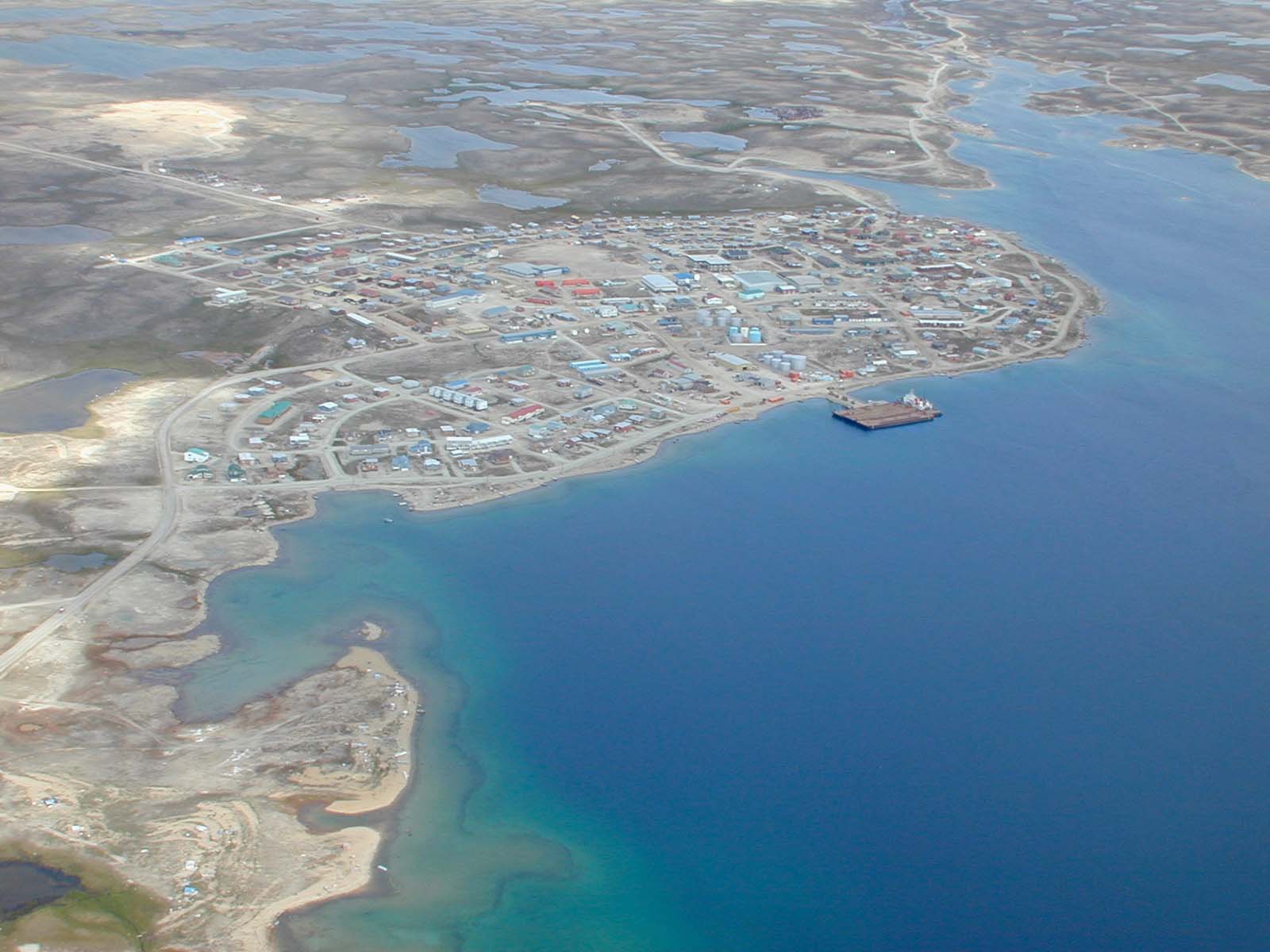
    After months of deliberation, the Canadian government has chosen Cambridge Bay — a hamlet midway along the Northwest Passage in the country’s far north — as the site for a world-class Arctic research station.

    Once built, the station will house scientists all year round, giving them a modern space to study Arctic issues, including climate change and natural resources. It will host conference facilities and laboratories for research on marine biology and geophysics, provide ecologists with the space to do long-term ecological monitoring in aquaria and greenhouses, and give researchers in the health and social sciences a base for their studies.

    “It’s a very exciting and long-awaited announcement,” says Warwick Vincent, director of the Centre for Northern Studies at Laval University in Quebec City, who was part of the committee consulted by the government during the selection process.

    The proposal for the Canadian research station was first sketched out in 2007 and a shortlist of sites was released in 2009. A Can$2-million (US$1.9-million) feasibility study for the proposed station established its functions, preliminary costs and construction schedule and involved an analysis of three possible locations: Pond Inlet, Resolute Bay and Cambridge Bay, all in the northern territory of Nunavut.

    Details about the new facility’s size or overall cost have yet to be released by the government, but sources suggest that it will be completed some time in 2017 at a cost of about Can$200 million.

    → Read more at the Nature website

    → Also found in WorldChanging’s Arctic Round-up (September 3)

  • Report maps perils of warming

    Report maps perils of warming

    Degree-by-degree breakdown of climate effects published.

    As the US Senate gears up to debate the latest incarnation of proposed climate legislation next week, a blue-ribbon panel has released what it hopes will be a definitive guide to the consequences of climate change for lawmakers and the public. In offering a degree-by-degree breakdown of the potential impacts of temperature change, the report aims to highlight the effects of stabilizing greenhouse gases at a chosen target level. Yet few are optimistic that the report will influence the fate of the scaled-back climate bill, which would cap emissions from electricity utility companies.

    The report, from the US National Research Council (NRC), sets out the consequences — from streamflow and wildfires to crop productivity and sea level rise — of different greenhouse-gas emissions scenarios. It also concludes that once the global average temperature warms beyond a certain point, Earth and future generations will be stuck with significant impacts for centuries or millennia.

    Previous assessments tended to tie predictions to specific years or concentrations of carbon dioxide in the atmosphere. But because no one knows the course of future carbon dioxide emissions, this approach amplifies the uncertainties. The NRC report instead sets out the effect of each additional degree of warming, whenever that might happen. “There are some very important future impacts of climate change that could be quantified somewhat better than we previously thought,” says Susan Solomon, a senior scientist at the National Oceanic and Atmospheric Administration in Boulder, Colorado, who chaired the report committee.

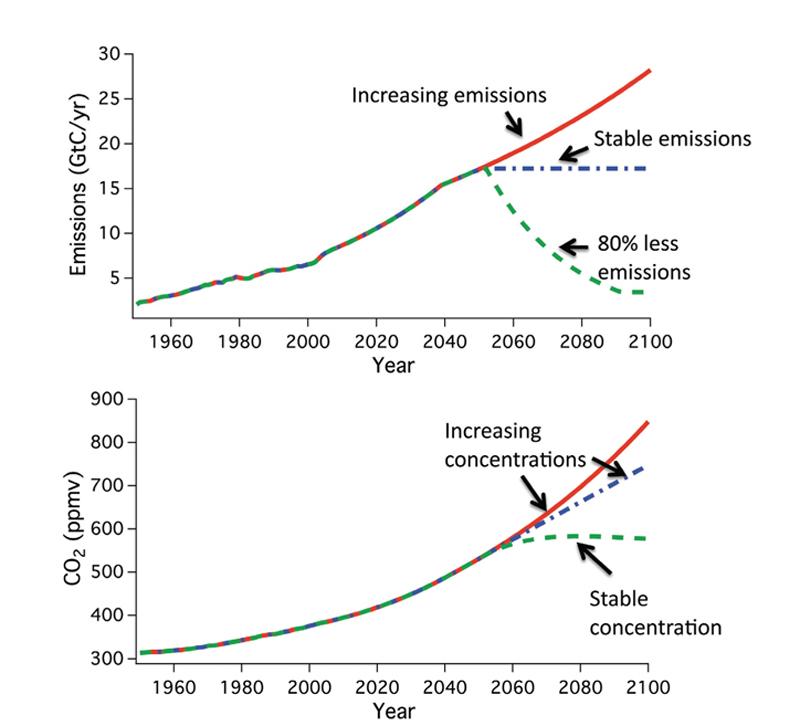
    For example, the report shows that each 1 °C of warming will reduce rain in the southwest of North America, the Mediterranean and southern Africa by 5–10%; cut yields of some crops, including maize (corn) and wheat, by 5–15%; and increase the area burned by wildfires in the western United States by 200–400%. The report also points out that even if the atmospheric concentration of carbon dioxide is stabilized, the world will continue to warm for decades. If concentrations rose to 550 parts per million, for example, the world would see an initial warming of 1.6 °C — but even if concentrations stabilized at this level, further warming would leave the total temperature rise closer to 3 °C, and would persist for millennia.

    “It is blunt, direct and clear. Unlike the IPCC reports you don’t see any hedge words.” — Steve Cohen, executive director of the Earth Institute at Columbia University in New York City.

    Deep cuts in carbon dioxide emissions would be needed throughout this century to avoid this long-term warming, something recognized in the American Power Act proposed by Senator John Kerry (Democrat, Massachusetts) and Senator Joe Lieberman (Independent, Connecticut). The bill aims to reduce emissions by 17% below 2005 levels by 2020 and by more than 80% by 2050.

    “The report says an 80% cut is meaningful,” says Jay Gulledge, director of the science and impacts programme at the Pew Center on Global Climate Change in Arlington, Virginia. “I’ve never seen that stated before, but it is based on the best calculations for the carbon cycle.”

    → Read more at Nature

  • Muslim students weigh in on evolution

    In Indonesia and Pakistan, questions about how science and faith can be reconciled.

    In the first large study of its kind, a survey of 3,800 high-school students in Indonesia and Pakistan has found that teachers are delivering conflicting messages about evolution.

    The Can$250,000 Islam and Evolution research project is the first large study of students, teachers and scientists in countries with significant Muslim populations to examine their understanding and acceptance of evolution. Some results from the three-year project were presented at a symposium at McGill University in Montreal, Canada, this week.

    “We now have empirical data for how Muslim students, teachers and scientists think about the subject,” says Brian Alters, the study’s lead investigator and director of the Evolution Education Research Center, a joint project between McGill and Harvard universities. “It was pretty much a black hole prior to this.”

    :: Read more at Nature ::