Category: science

  • Lady of the Lakes

    Lady of the Lakes

    Nature

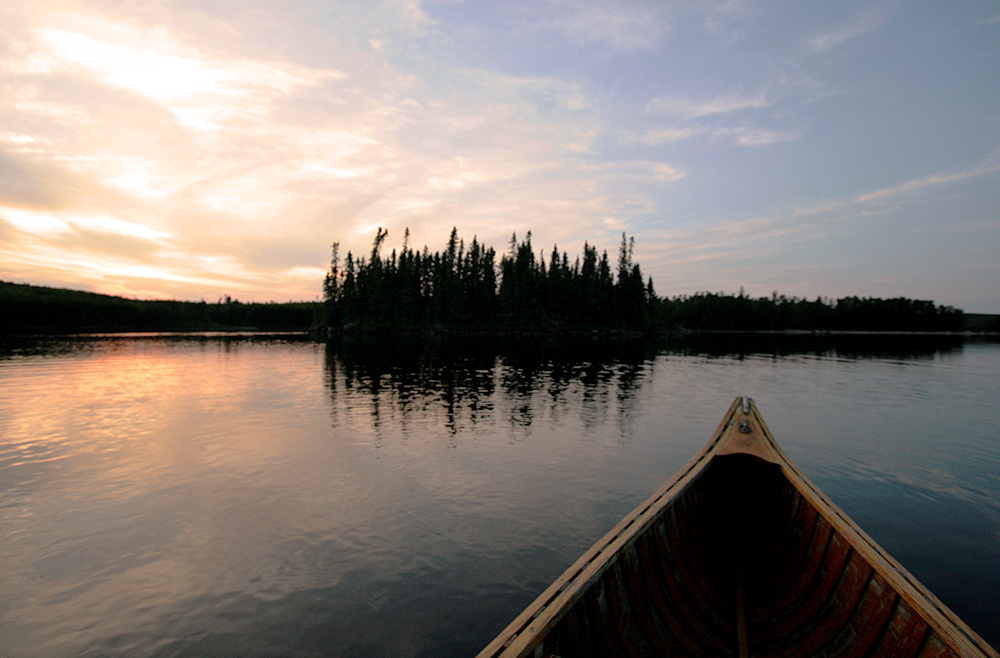
    Diane Orihel set her PhD aside to lead a massive protest when Canada tried to shut down its unique Experimental Lakes Area.

    It was an ominous way to start the day. When she arrived at work on the morning of 17 May 2012, Diane Orihel ran into distraught colleagues. Staff from Canada’s Experimental Lakes Area had just been called to an emergency meeting at the Freshwater Institute in Winnipeg. “It can’t be good,” said one. (more…)

  • Bats before bedtime

    Bats before bedtime

    Scientists find new animal species in old rainforests

    Deep in the heart of a small South American country called Guyana lies a protected forest. As night falls, you will find this tropical rainforest pulses with life. It is anything but quiet. The whistle of a bird called the screaming piha pierces the thick canopy of trees, as if competing with the chorus of crickets, cicadas and mosquitoes. Other strange creatures make themselves heard too. A sheep frog bleats while red howler monkeys spookily wail from the treetops. On this evening, it seems no one in the rainforest is sleeping — including the scientist making his way down a narrow path.

    Night is a great time to collect animals. To catch flying bats, it is also the only time. That is why Burton Lim is at work in the dark here in this forested region known as Iwokrama (EE WOE kram ah). It’s part of the greater Amazon ecosystem.

    Some people call Lim the Bat Man. He’s a curator of mammals at the Royal Ontario Museum, in Toronto, Canada. Tonight, he forges into the dark rainforest to look for bats. He’s wearing a bright headlamp and rubber boots. A machete hangs from his belt.

    Lim has come to the Iwokrama Forest because it is a hotspot for bats. Eighty-six species of them, roughly half of all the bats found across the Amazon, call this roughly circular zone of protected land home. The area is only about the size of Delaware. By comparison, the United States and Canada together host only 47 bat species.

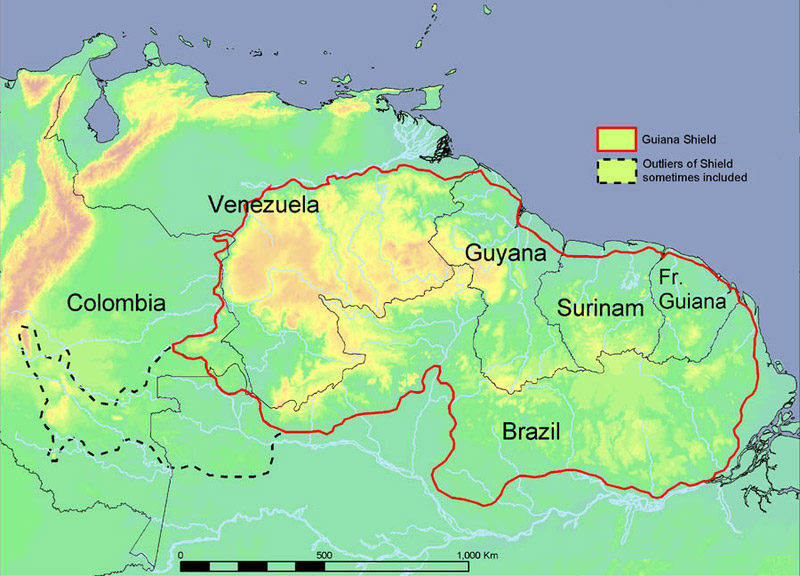
    A region called the Guiana Shield includes the South American countries of Guyana, Suriname, French Guyana and parts of Venezuela, Brazil and Colombia. Much of the tropical rainforest in this area is undisturbed. Credit: Shadowxfox, Wikimedia Commons

    Lim is on this expedition with a small team of scientists working with a conservation organization called Operation Wallacea. They’re here to study the rainforest’s large mammals, amphibians, birds, insects, reptiles and other animals. Luckily, a reporter for Science News for Kids is tagging along for part of the expedition. Exploring this richness of life, or biodiversity, lets scientists pinpoint areas that have rare or unique species. It also gives them clues useful in monitoring the health of this rainforest now — and in the future.

    Continue reading this story at Science News for Kids.

  • The Manning Awards: how four Canadian inventors became market leaders

    For three decades, the Ernest C. Manning Awards Foundation has recognized Canadians who develop and market successful innovations. This year, the awards are about imagination and stamina, says David Mitchell, the foundation’s president. Each of the four winners created a homegrown, breakthrough product. (Two of the prizes, the Innovation Awards, go to those who haven’t had access to research facilities or advanced education in their fields). All of the inventors refined their ideas constantly—sometimes over decades—until they had something they knew would make a difference.

    Critical deliveries

    Encana Principal Award $100,000

    In the mid-1990s, Geoffrey Auchinleck and his business partner Lyn Sherman visited a small hospital in England to sell an electronic system to manage their lab test requests. During the sales call, the laboratory manager listened politely, shook his head and pointed to a refrigerator of donor blood. Help me with that, he said.

    The lab manager fielded requests for blood transfusions and matched blood units to the patients. But after the units were picked up he lost control. Some units were transfused, others were returned or went missing. He needed a way to track who had picked up what, what had been used and how long a unit had been out of the fridge. It was basic information that could help the flow of a scarce resource.

    :: Read the full Maclean’s magazine article on this year’s Manning Award winners, Geoffrey Auchinleck (BloodTrack), Roger Lecomte (University of Sherbrooke, LabPet), Geoffrey Gyles and Kerry Green (Wolf Trax Inc.) and Terry Bigsby (Aspenware).


  • To catch a cheat

    To catch a cheat

    How officials are investigating blood dopers at the Olympics

    As part of Distillations three-part series on body fluids — Blood, Sweat, and Tears — I find out how Olympic officials are investigating blood dopers at this year’s games.

  • Radioactive medicine without the nuclear headache

    Radioactive medicine without the nuclear headache

    The Globe and Mail

    A made-in-Canada solution to our medical-isotope problem could come from a machine with a name that could have been pulled straight from the pages of a science fiction novel: the cyclotron.

    “It was really pooh-poohed, this idea of using cyclotrons; they said there was no way we could produce enough in a commercially meaningful way,” says John Wilson, the cyclotron facilities manager at the University of Alberta’s Cross Cancer Institute.

    In mid-2010, scientists at the University of Sherbrooke and the University of Alberta made technetium-99m, the most commonly used medical isotope, without a nuclear reactor. Last fall, the Alberta scientists began putting the cyclotron-produced technetium-99m through its paces, testing it in animals and humans, and found that the medical scans looked the same as those done using the regular stuff.

    Now they’re looking to make more of it using more powerful machines, to prove that a cross-country cyclotron network could meet most of Canada’s medical isotope needs. Success could lift the country from its dependency on the aging reactor at the Chalk River Laboratories near Ottawa.

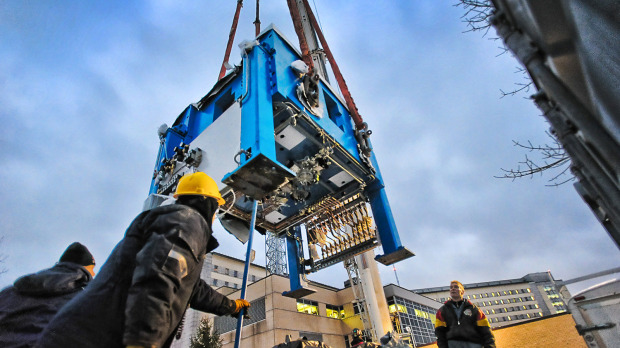
    Last week, the University of Sherbrooke received a higher-current cyclotron from Advanced Cyclotron Systems Inc., a company based in Richmond, B.C. The University of Alberta will install the same model in an old curling club on its south campus by the end of March.

    “Cyclotrons are a novel and very exciting way of producing technetium-99m,” says Kevin Tracey, vice-president of the Ontario Association of Nuclear Medicine and the medical director of nuclear medicine at Hôtel-Dieu Grace Hospital in Windsor.

    “There remain some technical impediments to making it efficient in day-to-day operations, but if we can produce it close to home, in our communities, that is a much better solution,” he says.

    Technetium-99m is the most common medical isotope used in the practice of nuclear medicine. About 80 per cent of all medical radioisotope tests—from cardiac perfusion tests to bone scans for cancer—require technetium-99m. In Canada, it’s used in roughly 1.8 million procedures annually.

    But there’s almost no natural technetium-99m on Earth. Instead it is produced via a precursor called molybdenum-99 that must be made in a nuclear reactor from highly enriched uranium.

    Keep reading this story in The Globe and Mail.