Category: technology

  • Using technology to find hidden graves

    Using technology to find hidden graves

    DISCOVER

    One morning in July 2005, Amy Mundorff rode into the Bosnian countryside, tagging along with a team from the International Commission on Missing Persons. The roads wound past forests, farmland and villages. The group stopped near a filed in a hilly area on the outskirts of a village to meet an informant. From the gestures and the translator’s comments, Mundorff understood that the ground beneath the field might hold bodies.

    The war in Bosnia-Herzegovina had ended 10 years earlier, but thousands of people remained missing, many presumed buried in hidden graves scattered across the country. Mundorff, a forensic anthropologist wanted to learn how the team excavated and exhumed graves, and then sorted and identified the co-mingled human remains–her area of expertise.

    Backhoes scraped away the topsoil, peeling back the earth inches at a time. “they just dug and dug and dug,” recalls Mundorff. Once in a while, the machinery operators would stop and call over an investigator. “It was never anything human. There were roots, animal bones, rocks…but there were no graves,” says Mundorff. By the end of the day, the entire hillside had been dug up, and the team found nothing.

    Witness and survivor testimonies remain the most reliable way to locate hidden graves, but the approach is not foolproof. Many of the conflicts under investigation occurred years ago. Elderly witnesses may have fading memories that offer incomplete or incorrect accounts of atrocities. Sometimes the geography of a place changes. Roads get rerouted, forest are cleared, and the edges of villages expand.

    Mundorff knew from her own searches for buried murder victims in the United States that investigators often fail to locate hidden graves, but she didn’t expect it to be so difficult in Bosnia-Herzegovina: The country is smaller than Louisiana, and the whereabouts of 8,000 people remain unknown.

    “Even if we didn’t find that one grave, I thought we would find something because…where are they?” says Mundorff. She was disappointed and frustrated. “I thought, ‘God, there has to be something better out there.’”

    Keep reading this story in Discover.

  • The Manning Awards: how four Canadian inventors became market leaders

    For three decades, the Ernest C. Manning Awards Foundation has recognized Canadians who develop and market successful innovations. This year, the awards are about imagination and stamina, says David Mitchell, the foundation’s president. Each of the four winners created a homegrown, breakthrough product. (Two of the prizes, the Innovation Awards, go to those who haven’t had access to research facilities or advanced education in their fields). All of the inventors refined their ideas constantly—sometimes over decades—until they had something they knew would make a difference.

    Critical deliveries

    Encana Principal Award $100,000

    In the mid-1990s, Geoffrey Auchinleck and his business partner Lyn Sherman visited a small hospital in England to sell an electronic system to manage their lab test requests. During the sales call, the laboratory manager listened politely, shook his head and pointed to a refrigerator of donor blood. Help me with that, he said.

    The lab manager fielded requests for blood transfusions and matched blood units to the patients. But after the units were picked up he lost control. Some units were transfused, others were returned or went missing. He needed a way to track who had picked up what, what had been used and how long a unit had been out of the fridge. It was basic information that could help the flow of a scarce resource.

    :: Read the full Maclean’s magazine article on this year’s Manning Award winners, Geoffrey Auchinleck (BloodTrack), Roger Lecomte (University of Sherbrooke, LabPet), Geoffrey Gyles and Kerry Green (Wolf Trax Inc.) and Terry Bigsby (Aspenware).


  • Canadian software helps Syrian activists avoid web censors

    Late last year, Syrian activists found their Internet connections blocked. In need of a way to communicate, they turned to a Canadian technology company to deliver the networking system.

    “The request was channelled through a number of different sources. They wanted a way of getting around Internet censorship,” says Rafal Rohozinski, CEO of the Psiphon Inc.

    In December, the company distributed Psiphon 3 to the activists. From his Ottawa headquarters, Rohozinski watched the number of online connections in Syria grow — to 30,000. The software enabled them to tunnel past Internet filters and barriers to websites, social media and other online communications technologies.

    “The act of communicating, of empowering yourself through knowledge, is an essential component of democratization,” says Rohozinksi.

    Psiphon grew out of an experiment at the Citizen Lab, a research and development program focused on the intersection of global security, human rights and cyberspace and based at the Munk School of Global Affairs at the University of Toronto.

    In 2003, the OpenNet Initiative, a group that tracks Internet censorship, found only a few countries filtered content. Today, it counts more than 40 countries controlling the online content that is accessed within their borders.

    “When you’re engaged in analyzing and tracking Internet censorship worldwide, you find out a lot about how Internet content is blocked on the web,” says Ron Deibert, director of the Citizen Lab and an investigator at the OpenNet Initiative.

    Deibert says people would contact the group to find out how to bypass the censors. Though circumvention technologies existed, they lacked security or required an almost hacker-like level of knowledge to operate, he says.

    The Citizen Lab set out to create software that lacked an Achilles heel.

    Keep reading this story in the Toronto Star.

  • Radioactive medicine without the nuclear headache

    Radioactive medicine without the nuclear headache

    The Globe and Mail

    A made-in-Canada solution to our medical-isotope problem could come from a machine with a name that could have been pulled straight from the pages of a science fiction novel: the cyclotron.

    “It was really pooh-poohed, this idea of using cyclotrons; they said there was no way we could produce enough in a commercially meaningful way,” says John Wilson, the cyclotron facilities manager at the University of Alberta’s Cross Cancer Institute.

    In mid-2010, scientists at the University of Sherbrooke and the University of Alberta made technetium-99m, the most commonly used medical isotope, without a nuclear reactor. Last fall, the Alberta scientists began putting the cyclotron-produced technetium-99m through its paces, testing it in animals and humans, and found that the medical scans looked the same as those done using the regular stuff.

    Now they’re looking to make more of it using more powerful machines, to prove that a cross-country cyclotron network could meet most of Canada’s medical isotope needs. Success could lift the country from its dependency on the aging reactor at the Chalk River Laboratories near Ottawa.

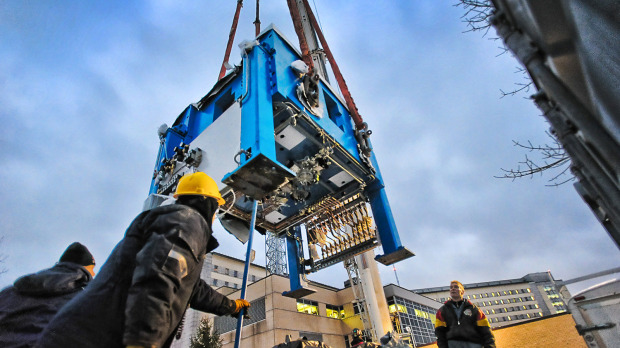
    Last week, the University of Sherbrooke received a higher-current cyclotron from Advanced Cyclotron Systems Inc., a company based in Richmond, B.C. The University of Alberta will install the same model in an old curling club on its south campus by the end of March.

    “Cyclotrons are a novel and very exciting way of producing technetium-99m,” says Kevin Tracey, vice-president of the Ontario Association of Nuclear Medicine and the medical director of nuclear medicine at Hôtel-Dieu Grace Hospital in Windsor.

    “There remain some technical impediments to making it efficient in day-to-day operations, but if we can produce it close to home, in our communities, that is a much better solution,” he says.

    Technetium-99m is the most common medical isotope used in the practice of nuclear medicine. About 80 per cent of all medical radioisotope tests—from cardiac perfusion tests to bone scans for cancer—require technetium-99m. In Canada, it’s used in roughly 1.8 million procedures annually.

    But there’s almost no natural technetium-99m on Earth. Instead it is produced via a precursor called molybdenum-99 that must be made in a nuclear reactor from highly enriched uranium.

    Keep reading this story in The Globe and Mail.
  • Think small

    The Canadian forestry industry could hinge on the most abundant nanomaterial on earth.

    A pale grey slurry roils about in a waist-high blue plastic drum at the centre of a garage-like space at the National Research Council’s Biotechnology Research Institute in Montreal. It looks a little like slush, but when it is dried it more closely resembles one of the fine white powders chefs stock in their kitchens. For the handful of chemists hovering about the room, it’s the stuff dreams are made of. For Canada’s faltering forestry industry, it is a beacon of optimism.

    Nanocrystalline cellulose (NCC) is nature’s Superman fibre; it is stronger than steel, lightweight and durable; its unique optical qualities make it desirable for use in everything from cosmetics and sunscreens to security documents, switchable optical filters, coatings and adhesives, and its anti-microbial properties open the door for a bunch of medical applications. All that from a little crystal made from tree trunks.

    It’s no surprise then that the Canadian forestry industry–straining under a slumped U.S. housing market and pricing pressures from developing countries–has high hopes that this possibly miraculous crystal will be their ticket to stage a much-needed comeback. The question now is, can this superhero compound make the leap from the lab, to large-scale production and into the marketplace?

    Read more in the April 2011 issue of Canadian Chemical News.