Tag: Canada

  • Glimmer of hope for freshwater research site

    Glimmer of hope for freshwater research site

    This story was originally posted on the Nature News Blog. 

    The government of Ontario, Canada, has stepped in to keep open the Experimental Lakes Area (ELA). The freshwater research facility, located in northern Ontario, was closed in March by the government of Canada, despite protests from scientists.

    Ontario premier Kathleen Wynne announced today that the government of Ontario will provide support to keep the ELA running this year and in the future, as it works to transfer the facility to the International Institute for Sustainable Development (IISD), a United Nations think tank based in Winnipeg, Manitoba.

    “We have had many conversations with members of the public and our scientific and academic communities who want to see the Experimental Lakes Area stay open,” Wynne said in a statement. But the statement did not elaborate on how much money the government has designated for operations, whether the facility will be fully operational this summer or the fate of the long-term climate data set the facility has kept up for 45 years. Meanwhile, the federal government released its own statement today noting that it “has been leading negotiations with third parties”.

    “We remain hopeful that an agreement can be reached and we welcome Ontario’s willingness to play an active role,” reads the statement from Fisheries and Oceans Canada.

    Many university scientists say that they are still not sure whether they will be able to continue their experimental work this summer. Several are sceptical that negotiations will be wrapped up in time for experiments to proceed as planned. “It’s somewhat exciting news, but quite frankly I don’t know what it means for us yet,” says Maggie Xenopoulos, an aquatic biologist at Trent University in Peterborough, Ontario. Xenopoulos and her colleagues had planned to contaminate one of ELA’s lakes with nanosilver this summer and measure its ecological impact.

    A statement from the IISD’s leader offered few specifics about its potential deal with the government of Ontario. “If the ELA does come to IISD, we would work with other stakeholders to ensure it remains an independent, world-class research facility that continues to produce leading-edge freshwater ecosystems science in the public domain and in the public interest,” said Scott Vaughan, the institute’s president and chief executive.

    Vincent St. Louis, a biogeochemist at the University of Alberta in Edmonton, says that the plan “is a good first start”. The plan to close the lake area “has always been baffling from a scientific perspective, given how much it provides at such a low cost,” says St. Louis, who has studied acid rain, reservoir creation and mercury emissions at the ELA — and would like to see scientists use the facility to study the impact of chemicals found in oil sands tailing ponds, such as polyaromatic hydrocarbons, on aquatic biota.

    The federal government announced last May that it would stop funding the facility, which cost about Can$2 million (US$2 million) to operate, and that it would begin a search for a new operator. Federal funding dried up on 31 March, and university scientists who had planned experiments for the summer field season were told that they were not allowed on the site.

  • Test lakes face closure

    Test lakes face closure

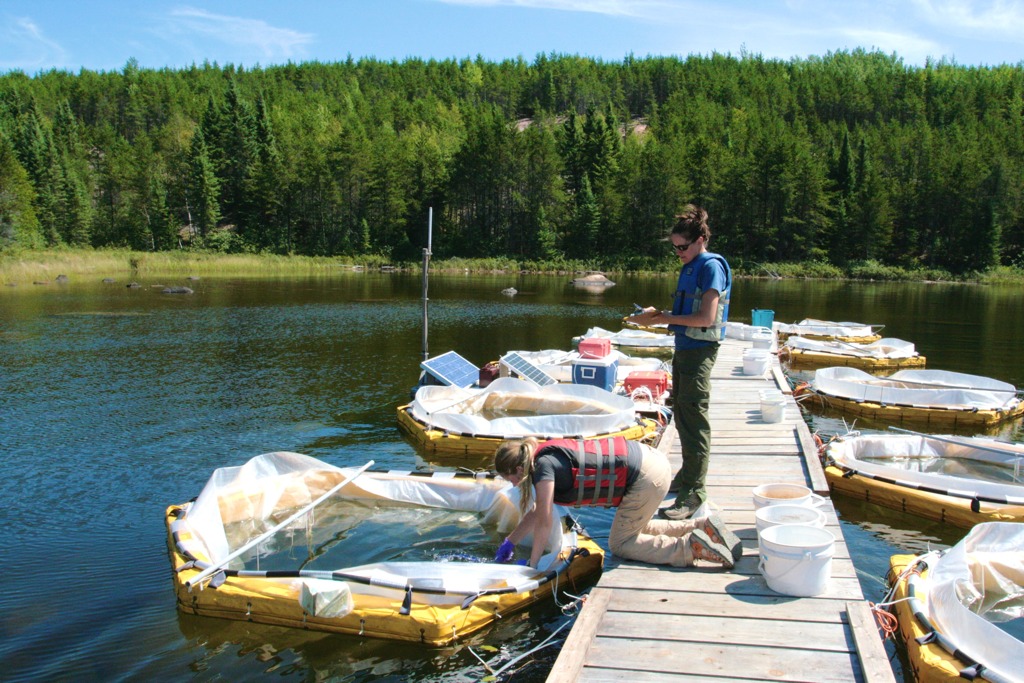
    Lake 239 looks inviting. Pines and spruce fringe the shoreline and waves lap against outcrops of weathered granite. But on this hot August afternoon in northwestern Ontario (see ‘Water works’), one feature stands out. At the far end of the 800-metre-long lake, a series of plastic-walled columns descend from a floating dock to the muddy bottom about 2 metres down. They are the sign that the lake’s placid setting disguises an experiment in controlled environmental abuse.

    Jennifer Vincent, a graduate student at Trent University in Peterborough, Ontario, kneels by one of the columns and empties a vial of silver nanoparticles into it. An iridescent purple cloud blooms in the water for a moment before the metal particles are mixed and disperse. These experiments are the first stage of a three-year, Can$720,000 (US$728,000) project to understand the biological effects of ‘nanosilver’ — an antibacterial agent commonly added to commercial products — and its possible effect on the environment. Previous work has shown that the chemical alters bacterial-community structure, affects algae and may change phosphorus cycling. Next year, the project intends to add nanosilver to an entire lake (Lake 222) and measure its effects across the ecosystem.

    With 58 such lakes serving as sites for a broad range of studies, the Experimental Lakes Area (ELA) is unique in the world. “I don’t take it lightly that you’re basically poisoning a lake,” says Chris Metcalfe, an environmental toxicologist from Trent University, and a leader on the project. But at the ELA, he adds, “you can graphically demonstrate what goes on in a whole lake ecosystem.”

    Yet the ELA project, with its laboratory buildings, residences and workshops, may soon disappear. Earlier this year, Canada announced that it would cease funding the ELA after March 2013, a development that dismayed scientists who have made use of the 44-year-old facility for investigations ranging from chemical contamination to the effects of climate change.

    The decision was unexpected. On 17 May, ELA employees at the Freshwater Institute in Winnipeg, were called to an emergency meeting, where they were told that the government was no longer interested in experiments requiring whole-lake manipulation. The 17 ELA staff at the institute, including four scientists, who are employed by the Department of Fisheries and Oceans (DFO), were told that their positions will be axed as of April 2013. (more…)

    Related stories

    More related stories

    Nature 488, 437–438

    Published 21 August 2012

  • Accord could make Canadian generics industry a ‘rust bucket’

    Accord could make Canadian generics industry a ‘rust bucket’

    A trade agreement in negotiations between Canada and the EU is drawing the ire of generic drugmakers, provincial governments and patient advocates over proposals to extend drug patents by several years in Canada, a move that critics say would delay the arrival of generic medicines to market in that country and inflate healthcare costs.

    According to Canada’s Department of Foreign Affairs and International Trade, Canada imports C$8.4 billion ($8.2 billion) of pharmaceutical products from the EU annually, making Canada the fifth largest export market for the continent’s drugmakers. The sweeping Comprehensive Economic and Trade Agreement (CETA) could add another $2.8 billion to the annual bill, according to a report by health economists Paul Grootendorst, from the University of Toronto, and Aidan Hollis, from the University of Calgary (J. Generic Med. 8, 81–103, 2011). This cost is largely shouldered by the provincial and territorial governments, which pay for healthcare.CETA—first proposed in 2009 and subsequently leaked in 2010—calls on Canada to beef up its intellectual property rights for pharmaceuticals. The proposed changes would add five years to patents for drugs that are unduly bogged down in the regulatory approval process, lengthen the period of time clinical trial data is kept off-limits for use by generics companies from eight years to ten years (or even longer in the case of pediatric drugs) and grant brand-name companies an appeal process to challenge generics companies on their patent compliance. (more…)

    Nature Medicine 18, 991 (2012)

    Published online 06 July 2012

  • Canada’s renowned freshwater research site to close

    Canada’s renowned freshwater research site to close

    [media-credit name=”USGS” align=”alignright” width=”199″][/media-credit]
    The Experimental Lakes Area near Kenora, Ontario has been used to study the effects of detergents, heavy metals and acid rain on lakes and their watersheds.
    Budget fall-out hits environmental research stations

    The Canadian government has cancelled its funding for the Experimental Lakes Area (ELA), a research site in northwestern Ontario that has led to the re-shaping of international policies. It is the latest target in a string of research programmes to have been scaled back, shut down or left in limbo in the wake of massive cuts to this year’s federal budget.

    Fisheries and Oceans Canada — the government department that runs the site —  told its staff on 17 May that the ELA, a collection of 58 remote lakes and a laboratory complex, would be shut down in March 2013. “It is completely shocking,” says Jim Elser, an aquatic ecologist at Arizona State University in Tempe, who ran experiments at the site in the 1990s. “It is sort of like the US government shutting down Los Alamos — its most important nuclear-physics site — or taking the world’s best telescope and turning it off.”

    The ELA has attracted scientists from around the world to its shores since field research started there in 1968. It is possibly the only place where aquatic scientists can use lakes and their ecosystems as test tubes as well as having access to long-term environmental data and a decent place to sleep and eat.

    Many scientists say that the government is making a mistake. “If you try to base policy on small-scale experiments you miss some key ecosystem process, and that can have huge implications,” says David Schindler, a freshwater scientist at the University of Alberta, who founded the ELA and ran it until 1989.

    Scientists have manipulated the area’s lakes to show how acid rain destroys lake ecosystems1, how the ingredients found in birth-control pills can cause the collapse of fish populations2 and how wetland flooding for hydroelectric dams leads to increased production in methyl mercury and greenhouse gases3, while unmanipulated lakes have provided long-term comparative data. Studies done there have influenced policy, most notably the creation of an air quality agreement between the United States and Canada in 1991, which led to reductions in acid rain.

    More in Nature.
  • Canadian budget bill undermines environment, critics charge

    Today in Canada’s House of Commons,  lawmakers debated a budget bill that critics say would gut a variety of environmental and species protection measures.

    The Jobs, Growth and Long-term Prosperity Act would allow the Conservative-led government to implement certain provisions included in the 2012 budget tabled just over a month ago (see ‘Canadian budget hits basic science‘). But the 420-page document includes “other measures,” which have angered the opposition, environmental groups and scientists.

    Bill C-38 aims to repeal the current Canadian Environmental Assessment Act, a federal law that promotes sustainable development, and rewrites the role of the National Energy Board, an independent agency that regulates the construction and operation of oil and natural gas pipelines that traverse provincial or international borders. The bill also relieves Canada from its duties under the Kyoto Protocol Implementation Act.

    The government says changes to the CEAA and NEB are necessary to streamline the environmental assessment process, make sure projects are reviewed in a timely manner and reduce duplicate assessments.

    The changes to the NEB would limit project reviews to two years, in an effort to avoid a repeat of the six-year review of the 1,200-kilometre long Mackenzie Valley natural gas pipeline that was finally approved in 2010. It would also give cabinet the final say on whether a project is approved. “In the past, there wasn’t a direct provision for the cabinet to overrule the decision and send it back for further review,” says Andrew Leach, an environmental economist at the University of Alberta, in Edmonton.

    Read the rest in Nature.