Tag: carbon dioxide

  • Mixed Reviews for Quebec’s Plan Nord

    Mixed Reviews for Quebec’s Plan Nord

    The government of Quebec (Canada) has launched its multibillion-dollar Plan Nord, which will open the vast northern reaches of the province to mining and energy development–and protect 50% of the territory from economic development.

    The 1.2-million-square-kilometre region—twice the size of France—is known for its wild rivers, biodiversity, diverse ecosystems and a large swath (about 20%) of Canada’s boreal forest. Boreal forest covers more than 25% of Quebec. More than 120,000 people, including 33,000 aboriginals also live in the region.

    Quebec Premier Jean Charest said yesterday the government will invest CDN$80 billion into mining, forestry, transportation, energy development and tourism over the next 25 years.

    The environmental aspects of the plan include the promise to set aside 600,000 square kilometres of the region to protect the environment and preserve biodiversity. By 2016, the government will have established several provincial parks, completed a survey of northern Quebec’s biodiversity, protected over 31,000 square kilometres of land, and adopted mitigation or restoration plans for each development project.

    By protecting half of the forest, the Quebec government will keep more than 13.8 billion tons of CO2 sequestered—equivalent to about 70 years of industrial carbon dioxide emissions in Canada (Canadian Boreal Initiative, 2009 release).

    The Plan Nord is getting mixed reviews from environmental groups. The Canadian Boreal Initiative, affiliated with the Pew Environment Group’s International Boreal Conservation Campaign applauded the sustainable development measures included within the plan (release). But others, including Greenpeace and Nature Quebec, said they could not endorse the plan as presented. The coalition of groups told the Globe and Mail the plan was “an attempt to regulate a mining boom rather than the expression of an authentic vision for the north.” They called for, among other things, an evaluation of the global environmental impacts of northern development.

    From the Nature News blog.

    Image: MRNF, Gouvernement du Quebec

  • Arctic Ocean full up with carbon dioxide

    Arctic Ocean full up with carbon dioxide

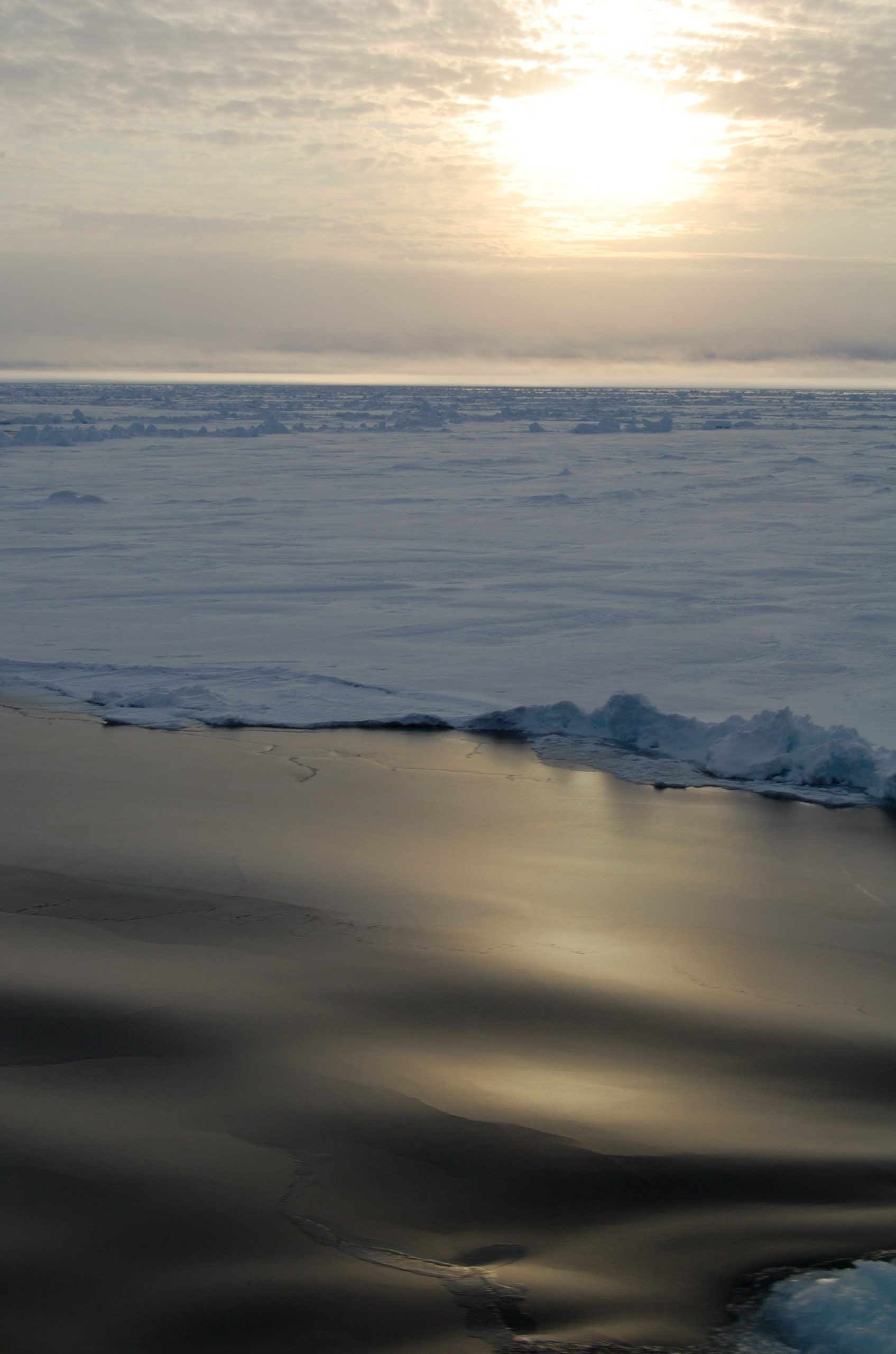
    Loss of sea ice is unlikely to enable Arctic waters to mop up more carbon dioxide from the air.

    As climate scientists watched the Arctic’s sea-ice cover shrink year after year, they thought there might be a silver lining: an ice-free Arctic Ocean could soak up large amounts of CO2 from the atmosphere, slowing down the accumulation of greenhouse gases and climate change.

    But research published in Science today suggests that part of the Arctic Ocean has already mopped up so much CO2 that it could have almost reached its limit1. Wei-Jun Cai, a biogeochemist at the University of Georgia in Athens and an international team sampled the amount of CO2 in the surface waters of the Canada Basin, in the western Arctic Ocean. “We found that ice-free basin areas had rather high CO2 values that approached atmospheric levels,” says Cai. “It was not expected.”

    Although the Arctic Ocean accounts for only 3% of the world’s ocean surface area and is mostly covered in ice, it takes up 5-14% of all the CO2 absorbed by the planet’s oceans. It tends to take in proportionately more CO2 because gases dissolve more easily in cold water.

    Scientists had previously thought that open water would promote the exchange of CO2 between the air and the ocean and that the increase in light reaching the water would also trigger the microscopic ocean plants called phytoplankton to transfer more CO2 from the atmosphere to the ocean through photosynthesis2.

    But that “prediction was based on observations of either highly productive ocean margins or ice-covered basins prior to a major ice retreat,” says Cai. Very few scientists had surveyed CO2 concentrations in offshore waters.

    → Read more at Nature

    Image courtesy of Pink floyd88 a, via Wikimedia Commons

  • Report maps perils of warming

    Report maps perils of warming

    Degree-by-degree breakdown of climate effects published.

    As the US Senate gears up to debate the latest incarnation of proposed climate legislation next week, a blue-ribbon panel has released what it hopes will be a definitive guide to the consequences of climate change for lawmakers and the public. In offering a degree-by-degree breakdown of the potential impacts of temperature change, the report aims to highlight the effects of stabilizing greenhouse gases at a chosen target level. Yet few are optimistic that the report will influence the fate of the scaled-back climate bill, which would cap emissions from electricity utility companies.

    The report, from the US National Research Council (NRC), sets out the consequences — from streamflow and wildfires to crop productivity and sea level rise — of different greenhouse-gas emissions scenarios. It also concludes that once the global average temperature warms beyond a certain point, Earth and future generations will be stuck with significant impacts for centuries or millennia.

    Previous assessments tended to tie predictions to specific years or concentrations of carbon dioxide in the atmosphere. But because no one knows the course of future carbon dioxide emissions, this approach amplifies the uncertainties. The NRC report instead sets out the effect of each additional degree of warming, whenever that might happen. “There are some very important future impacts of climate change that could be quantified somewhat better than we previously thought,” says Susan Solomon, a senior scientist at the National Oceanic and Atmospheric Administration in Boulder, Colorado, who chaired the report committee.

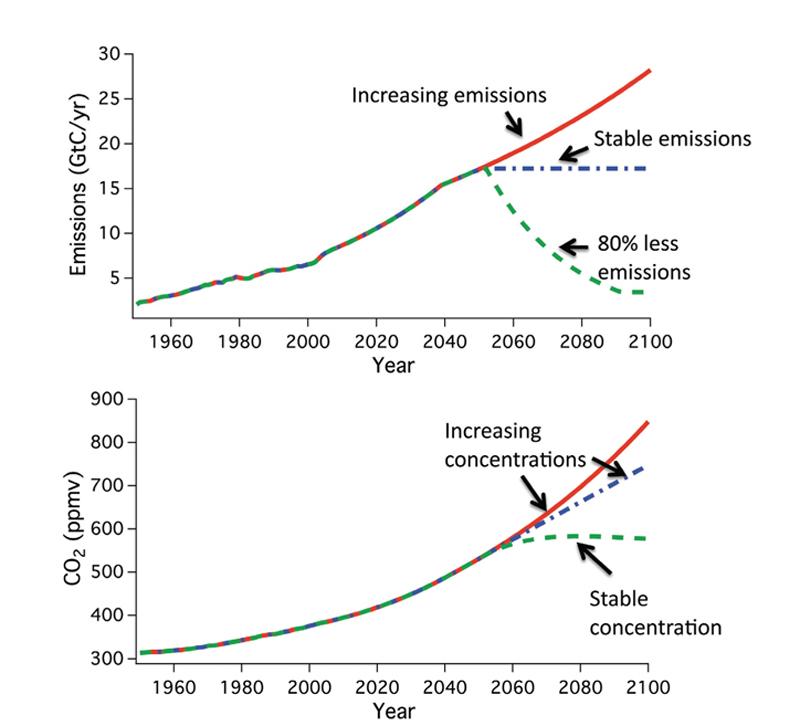
    For example, the report shows that each 1 °C of warming will reduce rain in the southwest of North America, the Mediterranean and southern Africa by 5–10%; cut yields of some crops, including maize (corn) and wheat, by 5–15%; and increase the area burned by wildfires in the western United States by 200–400%. The report also points out that even if the atmospheric concentration of carbon dioxide is stabilized, the world will continue to warm for decades. If concentrations rose to 550 parts per million, for example, the world would see an initial warming of 1.6 °C — but even if concentrations stabilized at this level, further warming would leave the total temperature rise closer to 3 °C, and would persist for millennia.

    “It is blunt, direct and clear. Unlike the IPCC reports you don’t see any hedge words.” — Steve Cohen, executive director of the Earth Institute at Columbia University in New York City.

    Deep cuts in carbon dioxide emissions would be needed throughout this century to avoid this long-term warming, something recognized in the American Power Act proposed by Senator John Kerry (Democrat, Massachusetts) and Senator Joe Lieberman (Independent, Connecticut). The bill aims to reduce emissions by 17% below 2005 levels by 2020 and by more than 80% by 2050.

    “The report says an 80% cut is meaningful,” says Jay Gulledge, director of the science and impacts programme at the Pew Center on Global Climate Change in Arlington, Virginia. “I’ve never seen that stated before, but it is based on the best calculations for the carbon cycle.”

    → Read more at Nature