Tag: Guyana

  • In carbon sequestration, money grows on trees

    In carbon sequestration, money grows on trees

    Guyana’s tropical rainforests protected under the REDD program provide not just natural resources but an income stream to the country.

    Two hours south of Georgetown, Guyana, a paved highway recedes, giving way to a rutted red road gushing through thick rainforest. In its muddiest spots, the road swallows trucks and spits them out at dangerous angles. Many hours later, it leads to an area of protected land called Iwokrama, a Rhode Island-size forest in the heart of Guyana, crowded with ancient buttress-trunked trees draped in liana vines.

    [media-credit name=”Hannah Hoag” align=”alignleft” width=”300″]red-mud-guyana[/media-credit]Since 2003, Jake Bicknell has been a fixture within this forest. Now a doctoral student in biodiversity management at the U.K.’s University of Kent, he is cataloging Iwokrama’s iconic and bizarre species, including jaguars, giant anteaters, anacondas, and scads of birds and bats. (Guyana boasts more than 700 bird and 120 bat species.)

    Specifically, he’s in Iwokrama to find out how logging affects tropical forest wildlife. Conventional logging ruins forests and decimates species, but low-impact methods of harvesting timber might not be so damaging. In fact, Bicknell believes selective logging can become a tool for protecting the forests and biodiversity of Guyana — a developing country eager to tap its natural resources as a way to boost its economy.

    “There will always be a market for products extracted from forests, so the point is to do it in the least impacting way,” says Bicknell.

    Keep reading this story in the November 2013 issue of Discover

  • Bats before bedtime

    Bats before bedtime

    Scientists find new animal species in old rainforests

    Deep in the heart of a small South American country called Guyana lies a protected forest. As night falls, you will find this tropical rainforest pulses with life. It is anything but quiet. The whistle of a bird called the screaming piha pierces the thick canopy of trees, as if competing with the chorus of crickets, cicadas and mosquitoes. Other strange creatures make themselves heard too. A sheep frog bleats while red howler monkeys spookily wail from the treetops. On this evening, it seems no one in the rainforest is sleeping — including the scientist making his way down a narrow path.

    Night is a great time to collect animals. To catch flying bats, it is also the only time. That is why Burton Lim is at work in the dark here in this forested region known as Iwokrama (EE WOE kram ah). It’s part of the greater Amazon ecosystem.

    Some people call Lim the Bat Man. He’s a curator of mammals at the Royal Ontario Museum, in Toronto, Canada. Tonight, he forges into the dark rainforest to look for bats. He’s wearing a bright headlamp and rubber boots. A machete hangs from his belt.

    Lim has come to the Iwokrama Forest because it is a hotspot for bats. Eighty-six species of them, roughly half of all the bats found across the Amazon, call this roughly circular zone of protected land home. The area is only about the size of Delaware. By comparison, the United States and Canada together host only 47 bat species.

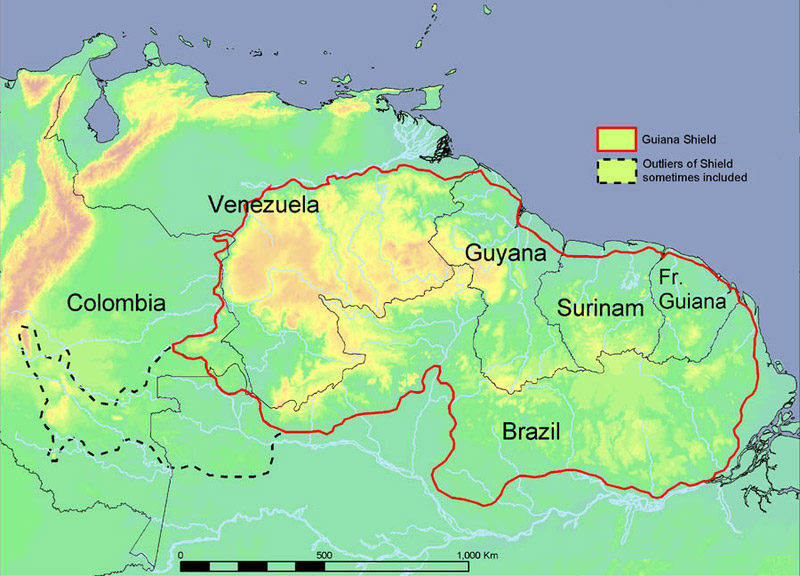
    A region called the Guiana Shield includes the South American countries of Guyana, Suriname, French Guyana and parts of Venezuela, Brazil and Colombia. Much of the tropical rainforest in this area is undisturbed. Credit: Shadowxfox, Wikimedia Commons

    Lim is on this expedition with a small team of scientists working with a conservation organization called Operation Wallacea. They’re here to study the rainforest’s large mammals, amphibians, birds, insects, reptiles and other animals. Luckily, a reporter for Science News for Kids is tagging along for part of the expedition. Exploring this richness of life, or biodiversity, lets scientists pinpoint areas that have rare or unique species. It also gives them clues useful in monitoring the health of this rainforest now — and in the future.

    Continue reading this story at Science News for Kids.