Tag: Nature News

  • Plants flowering later on the Tibetan Plateau

    Shorter growing season linked to warmer winters on ‘the roof of the world’.

    In many regions, climate change has advanced the timing of spring events, such as flowering or the unfolding of leaves. But the meadows and steppes of the Tibetan Plateau are bucking that trend — plants are starting to bloom later in spring, making the growing season shorter. This change could threaten the livelihood of the thousands of nomads who survive by raising cattle on the plateau.

    “I’ve worked in the Tibetan Plateau region for 25 years,” says Jianchu Xu, an ethnoecologist at the World Agroforestry Centre in Kunming, China, and a professor at the Kunming Institute of Botany of the Chinese Academy of Sciences, who led the study, published this week in theProceedings of the National Academy of Sciences. Xu says he expected that plants on the plateau would follow the same pattern of early flowering seen elsewhere. In Europe, for instance, spring flowerings in 2000 occurred about 8 days earlier than they did in 1971 on average, and autumn events, such as changes in leaf colour, about 3 days earlier.

    “But then my PhD student Haiying Yu looked at more recent data” and discovered that the opposite was the case. The finding “contradicted the linear link” that is often seen between warming temperatures and an earlier start to the growing season, Xu says.

    The group used satellite data to identify the start, end and length of the growing season for the meadow and steppe vegetation of the Tibetan Plateau between 1982 and 2006, and linked it to temperature change. During this time, the mean temperature rose about 1.4 ºC on the steppes and 1.25 ºC on the lower-lying meadows.

    The study showed an initial advance in the timing of the growing season or its ‘phenology’ for both the meadow and steppe for the first 15 years. But from 2000 until 2006 that trend was reversed. The net effect was a shortening of the growing season by about one month for steppe plants and three weeks for meadow vegetation.

    Continue reading over at Nature News.

  • US polar bears mark their territory

    US polar bears mark their territory

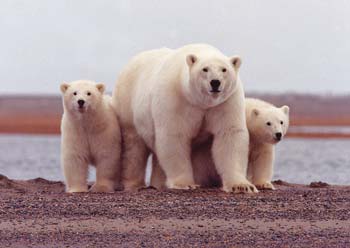
    More than two years after Alaskan polar bears were given a protection status of “threatened species” by the US Endangered Species Act, the Obama administration set aside on Wednesday 24 November 484,330 sq kilometres — twice the size of the UK — in Alaska as “critical habitat”.

    Almost all of the area is offshore sea ice habitat — where polar bears spend most of their time hunting seals, breeding and travelling—in the Beaufort and Chukchi seas off Alaska’s northern coast. It also includes on-shore barrier islands and land used for making dens. About 4,800 polar bears ramble along Alaska’s ice and shores.

    The story continues at Nature’s blog The Great Beyond

  • Taxonomy in Trouble in Canada

    Taxonomy in Trouble in Canada

    Canada is at risk of losing its taxonomic expertise, according to a report released today.

    The report details stagnant research funding, greying experts, a lag in digitization and a lack of support for national collections. This is threatening Canada’s understanding of its biodiversity, and the ecosystem services it provides, the report concludes.

    “Canadian contributions to describing new species has dropped from being 6th in the world to 14th in the last decade,” says Thomas Lovejoy, Biodiversity Chair at the Heinz Center for Science, Economics and the Environment, who chaired the panel of 14 Canadian and international experts who authored the report. “The taxonomic expertise in Canada is slipping at the moment when it needs to surge forward.”

    The effects are already being felt. The Committee on the Status of Endangered Wildlife in Canada recently filled positions on its subcommittees with outside experts because not enough Canadians had expertise in several taxonomic groups, including terrestrial and freshwater molluscs, lichens and mosses, the report says.

    Canada has more than 50 million wildlife specimens in collections worth over CDN$250 million, but there is no strategy for their maintenance, says David Green, director of the Redpath Museum at McGill University in Montreal. There are few storage facilities with advanced climate and pest control systems, and many are bulging beyond capacity.

    The story continues on Nature’s blog The Great Beyond.

  • Canada’s climate bill flattened

    “Spitting mad,” is how the Victoria Times Colonist described Andrew Weaver, a climate modeller at the University of Victoria in British Columbia, following the news that Canada’s climate change bill had been defeated in the Senate late on Tuesday. “Retiring with a bottle of Jack Daniel’s sounds good right now,” Weaver said.

    The Climate Change Accountability Act called for greenhouse gas emissions cuts with a short-term target of 25% below the 1990 level by 2020, and a long-term target of 80% below the 1990 level by 2050. For nearly a year and a half it had shuttled between the House of Commons and its environment committee before being passed by the House on 5 May, supported by all three of Canada’s opposition parties. It then languished in the Senate, until it was voted down 43-32 this week.

    The story continues at Nature’s blog The Great Beyond

  • Cold cash for cold science

    Cold cash for cold science

    The recent funding wrap-up from the international polar year (IPY) has left many Canadian researchers scratching their heads, trying to find a way to continue their arctic science projects. A new grant from the Natural Sciences and Engineering Research Council of Canada may help close that research-funding gap.

    In its announcement yesterday, NSERC opened a competition to fund large-scale research with a focus—for this round of funding—on northern earth systems. The Discovery Frontiers initiative will heft Can$4 million over five years on the successful research team to study the physical, chemical, biological and social factors that affect the North and its inhabitants—and to come up with solutions. Fresh water, sea level, permafrost, weather patterns, biodiversity or climate change adaptation could be part of the successful pitch. The northern community will help define the projects and their goals.

    The story continues at Nature’s blog The Great Beyond.