Tag: permafrost

  • Arctic snow cover shows sharp decline

    Arctic snow cover shows sharp decline

    Earlier spring could spell trouble for permafrost

    Arctic snow is fading fast. June snow cover in the Northern Hemisphere has dropped by almost 18% per decade during the past 30 years, according to a study published in Geophysical Research Letters1.

    The drop in snow extent will lower the amount of sunlight reflected away from the planet — a process that has a cooling effect — by exposing darker and less reflective soil, shrubs and trees, which absorb solar radiation and re-emit the heat into the atmosphere. The change also stands to warm the permafrost, alter the timing of spring runoff into rivers and lead to earlier plant growth in spring.

    “It was a bigger number than we initially thought we might have seen, but when you look at the changes in Arctic sea ice, we would expect a similarly large number,” says Chris Derksen, a cryosphere scientist at Environment Canada in Toronto and a co-author on the paper. The swift pace of the snowmelt between 1979 and 2011 exceeds the rate of decline in Arctic sea ice, which clocked in at just under 11% per decade over the same period. September 2012 saw the lowest extent of sea ice in the satellite record — and when this year’s data were included in calculations, they revealed a 13% per decade decline in sea ice and a 21.5% per decade drop in snow cover.

    :: Get the full story at the Nature News website

  • Cold cash for cold science

    Cold cash for cold science

    The recent funding wrap-up from the international polar year (IPY) has left many Canadian researchers scratching their heads, trying to find a way to continue their arctic science projects. A new grant from the Natural Sciences and Engineering Research Council of Canada may help close that research-funding gap.

    In its announcement yesterday, NSERC opened a competition to fund large-scale research with a focus—for this round of funding—on northern earth systems. The Discovery Frontiers initiative will heft Can$4 million over five years on the successful research team to study the physical, chemical, biological and social factors that affect the North and its inhabitants—and to come up with solutions. Fresh water, sea level, permafrost, weather patterns, biodiversity or climate change adaptation could be part of the successful pitch. The northern community will help define the projects and their goals.

    The story continues at Nature’s blog The Great Beyond.

  • Permafrost that lives up to its name

    Permafrost that lives up to its name

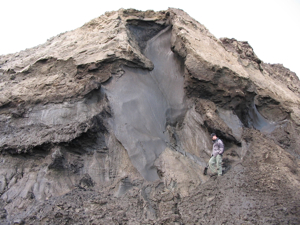
    Ancient Canadian ice survived previous warm periods.

    A 740,000-year-old wedge of ice discovered in central Yukon Territory, Canada, is the oldest known ice in North America. It suggests that permafrost has survived climates warmer than today’s, according to a new study.

    “Previously, it was thought that the permafrost had completely disappeared from the interior about 120,000 years ago,” says Duane Froese, an earth scientist at the University of Alberta in Edmonton, Canada, who is the author of the study published today in Science. “This deep permafrost appears to have been stable for more than 700,000 years, including several periods that were warmer and wetter.”

    Keep reading in Nature.

    Image credit: Duane Froese, University of Alberta

  • Rapid Ice Retreat Threatens Arctic Interior

    Rapid Ice Retreat Threatens Arctic Interior

    Nature Reports: Climate Change

    The rapid decline of sea ice could accelerate inland warming over the Arctic region, radically transforming the landscape.

    One of the Northern Hemisphere’s natural cycles is the expansion and contraction of the floating Arctic ice cap. Typically, sea ice decreases during the Arctic summer, reaching a low in September, before recovering as temperatures drop in winter. From as far back as satellite measurements began in 1978 until 2000, the average sea-ice extent, or the area of ocean covered by at least 15 per cent ice, has routinely hovered around 7 million square kilometres during the summer minimum.

    But in 2002, scientists noticed a sharp drop in the region’s minimum ice coverage. By September 2007, the area covered by ice had been whittled down to a startling 4.3 million square kilometres — 40 per cent smaller than in the 1980s. Scientists say the retreat witnessed last year was drastic, unexpected and more than 20 per cent below the previous record minimum.

    Not only will the loss affect the marine ecosystem and its dependents, from indigenous communities to marine mammals that rely on the ice for hunting and travel; it stands to alter the Arctic landscape much further afield. According to a new study in the 13 June issue of Geophysical Research Letters, the rapid retreat of Arctic sea ice could accelerate warming 1,500 kilometres inland in northern Alaska, Canada and Russia. During rapid ice retreat, the rate of inland warming could be more than three times that previously predicted from global climate models.

    :: Read more in Nature Reports: Climate Change ::