Tag: policy

  • Canadian satellite system under budget cloud

    Canadian satellite system under budget cloud

    Nature

    Missed deadlines and an underfunded Canada Space Agency (CSA) may scuttle plans to build the next generation of earth observing satellites, according to the Canadian satellite company pegged to build them.

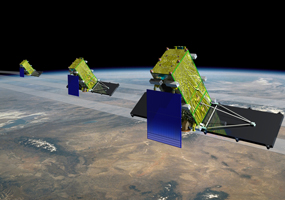
    In 2010, the CSA selected MacDonald, Detwillier and Associates Ltd. to design the successor to Radarsat-2, the agency’s current earth observing satellite. The company came up with a three-satellite system that would provide information for maritime surveillance, disaster management and ecosystem monitoring. But Dan Friedman, the company’s president and chief executive officer, says the federal government missed a target deadline for awarding the building contract in January, according to a story in the Globe and Mail and the CSA may not have enough money for the project.

    The Radarsat Constellation calls for three satellites (scalable to six) to maintain a polar orbit and provide radar images of nearly all of Canada’s land and waters. The Constellation would monitor ice and icebergs, winds and oil pollution in shipping lanes and coastal zones on a daily basis. It would also provide information on the state of Canada’s forests, changes to vegetation in protected areas and important wildlife habitat, and monitor wetlands and coastal change.  Unlike Radarsat-2, which is owned by MDA, the Canadian government would own Constellation.

    Canada’s Earth observing satellites, Radarsat-1 and -2, have been important in mapping natural disasters, such as the 2011 flooding in Queensland, Australia, as well as the Antarctic’s glaciers and ice sheets. including a subsurface view of the ice-covered Lake Vostok.

    Keep reading this story at Nature.

  • Canadian budget bill undermines environment, critics charge

    Today in Canada’s House of Commons,  lawmakers debated a budget bill that critics say would gut a variety of environmental and species protection measures.

    The Jobs, Growth and Long-term Prosperity Act would allow the Conservative-led government to implement certain provisions included in the 2012 budget tabled just over a month ago (see ‘Canadian budget hits basic science‘). But the 420-page document includes “other measures,” which have angered the opposition, environmental groups and scientists.

    Bill C-38 aims to repeal the current Canadian Environmental Assessment Act, a federal law that promotes sustainable development, and rewrites the role of the National Energy Board, an independent agency that regulates the construction and operation of oil and natural gas pipelines that traverse provincial or international borders. The bill also relieves Canada from its duties under the Kyoto Protocol Implementation Act.

    The government says changes to the CEAA and NEB are necessary to streamline the environmental assessment process, make sure projects are reviewed in a timely manner and reduce duplicate assessments.

    The changes to the NEB would limit project reviews to two years, in an effort to avoid a repeat of the six-year review of the 1,200-kilometre long Mackenzie Valley natural gas pipeline that was finally approved in 2010. It would also give cabinet the final say on whether a project is approved. “In the past, there wasn’t a direct provision for the cabinet to overrule the decision and send it back for further review,” says Andrew Leach, an environmental economist at the University of Alberta, in Edmonton.

    Read the rest in Nature.
  • Canada urged to tackle scientific misconduct

    More education, advice and transparency needed to improve integrity.

    As cases of questionable conduct among scientists stack up around the globe, a report commissioned by the Canadian government calls for a rethink of the country’s research system to boost honesty and curb misconduct.

    The recommendations, if implemented, would relax privacy laws that hamper the identification of individuals and institutions found guilty of research misconduct, and create an independent council to promote best practices and prevent research misconduct.

    The Council of Canadian Academies (CCA) — a not-for-profit corporation based in Ottawa that independently assesses science relevant to public issues — released the report1 today. “We look reasonably good compared to other countries in the world, but it is the committee’s conclusion that we have to do better,” says Paul Davenport, chairman of the panel responsible for the report and former president of the University of Western Ontario in London.

    In the current system, researchers aren’t assured of equal treatment from one university to the next when accused of misconduct, says James Turk, executive director of the Canadian Association of University Teachers in Ottawa. “It is a dog’s breakfast. It is not a suitable way to deal with such an important issue, and it doesn’t instil confidence into the public, which is vital,” he says.

    Keep reading over at Nature News.

  • Canadian science minister under fire

    Comments on evolution spark fierce criticism.

    It’s been a rough month for Canada’s minister of science and technology. Gary Goodyear, who was appointed to the new position in October 2008, has been roundly criticized in the media for an outburst during a meeting with a university teachers’ group and for his comments on evolution.

    Some Canadian researchers say the criticism is unreasonable, but others say it suggests that Goodyear, a chiropractor by training, is not in tune with the community whose portfolio he oversees.

    :: Keep reading in Nature ::

  • Canadian research infrastructure receives support, but will it last?

    Investment in infrastructure typically brings to mind hard-hat projects such as the construction of highways. But to keep science on the fast track, focused funding of research infrastructure is necessary. Following this logic, in December the Canada Foundation for Innovation (CFI) announced it would award C$45.5 million ($35.9 million) to specific Canadian research projects. The investment will support more than 250 projects, including those in the health field, by providing equipment to attract and retain researchers to Canadian institutions.

    The money will be distributed through two channels: the Leaders Opportunity Fund, which allows institutions to invest in research equipment for new or existing faculty, and the Infrastructure Operating Fund, a smaller accompanying program that covers a portion of the operating and maintenance costs of CFI-supported infrastructure projects.

    “We’re really pleased,” says Peter Lewis, vice dean of research at the University of Toronto’s Faculty of Medicine. “It’s been quite catalytic to get researchers to work together on projects that they might not have been able to otherwise.”

    :: continue reading in Nature Medicine :: (subscription required)